Leelanau County Vacant Land Market: 2016–2025 Trends, Pricing Power, and What It Means for Buyers & Sellers

Leelanau County Vacant Land Market: 2016–2025
Trends, Pricing Power, and What It Means for Buyers & Sellers

If you’re looking at vacant land in Leelanau County, the data tells a very clear story: land is scarce, demand is persistent, and pricing power has shifted decisively toward well-located parcels.

Using Northern Great Lakes Realtors MLS data from 2016 through 2025, here’s what actually happened—and why it matters if you’re buying or selling land in Leelanau County today.

Vacant Land Sales: Fewer Deals, Not Fading Demand

From 2016 through 2019, vacant land sales were fairly stable, averaging roughly 200–240 parcels per year. Then came the pandemic-era surge:

  • 2020: 327 parcels sold

  • 2021: 412 parcels sold (the decade high)

That spike wasn’t random. Buyers rushed to secure land for future homes, investment, or lifestyle properties as remote work became normal and Leelanau County jumped onto the national radar.

Since then, sales volume has cooled:

  • 2022: 278 sales

  • 2023: 168 sales

  • 2024: 197 sales

  • 2025: 193 sales

Here’s the key takeaway most people miss:
📉 Lower unit sales do not mean lower demand.
They mean less inventory and more selective buyers.

Dollar Volume Tells the Real Story

Now look at the money.

Even with fewer parcels changing hands after 2021, total dollar volume stayed strong:

  • 2021: $71.1M (record year)

  • 2022: $47.8M

  • 2023: $31.2M

  • 2024: $36.7M

  • 2025: $46.9M

In fact, 2025 dollar volume nearly matched 2022, despite 85 fewer parcels sold.

That means:
➡️ Average land prices are significantly higher than pre-2020
➡️ Buyers are paying more per parcel, especially for buildable, view, waterfront, or well-located tracts

Translation: cheap land is the unicorn. You might hear about it, but you won’t see it.

Inventory: The Silent Constraint

The inventory chart is the mic-drop moment.

From 2016 to early 2020, Leelanau County routinely had 1,000–1,300 active vacant land listings. Then the market changed—fast.

  • 2021: Inventory collapsed

  • 2022–2025: Inventory remained historically low, bouncing between roughly 250–450 active listings

That’s a 60–75% reduction compared to pre-pandemic levels.

And here’s why that matters:

  • Fewer sellers are willing to let land go

  • Builders and long-term owners are holding

  • Desirable parcels are absorbed quickly when priced right

Low inventory is the real reason prices are holding—not speculation, not hype.

What This Means if You’re Buying Vacant Land

If you’re a buyer in Leelanau County:

  • You need to move faster than pre-2020 norms

  • “Waiting for prices to crash” hasn’t been a winning strategy

  • Buildable land with utilities, road frontage, or views is still commanding premiums

Smart buyers are focusing on:

  • Parcels with realistic building potential

  • Zoning and setback clarity

  • Long-term utility, not just acreage count

What This Means if You’re Selling Vacant Land

If you own vacant land, this is not the market to underprice—or overprice.

The data suggests:

  • Well-positioned parcels sell, even in slower years

  • Pricing accuracy matters more than ever

  • Buyers are sophisticated and expect strong value, not guesswork

The biggest mistake sellers make?
❌ Relying on outdated comps from pre-2020 inventory levels.

The Bottom Line on Leelanau County Vacant Land

From 2016 to 2025, Leelanau County’s vacant land market transformed:

  • Fewer listings

  • Fewer total transactions

  • Higher average prices

  • Sustained demand

This is no longer a high-volume land market—it’s a precision market. The winners are the buyers and sellers who understand the numbers, not the noise.

If you’re thinking about buying or selling vacant land in Leelanau County, the data doesn’t just help—it protects you from costly assumptions.

Thinking About Vacant Land in Leelanau County?

Whether you’re looking for a home site, an investment parcel, or you’re sitting on land and wondering what it’s worth in today’s market, having a hyper-local perspective matters.

I track this data closely because in a market like Leelanau County, details decide outcomes.

If you want a straight answer—not a sales pitch—I’m always happy to talk land.

Need Expert Real Estate Advice in Leelanau County or Suttons Bay? Contact Jonathan Oltersdorf Today!

For personalized insights into Leelanau County real estate, reach out to Jonathan Oltersdorf at Oltersdorf Realty, LLC.

📞 Office Phone: 231-271-7777
📧 Email: jonathan@oltersdorf.com
🌐 Website: www.oltersdorf.com
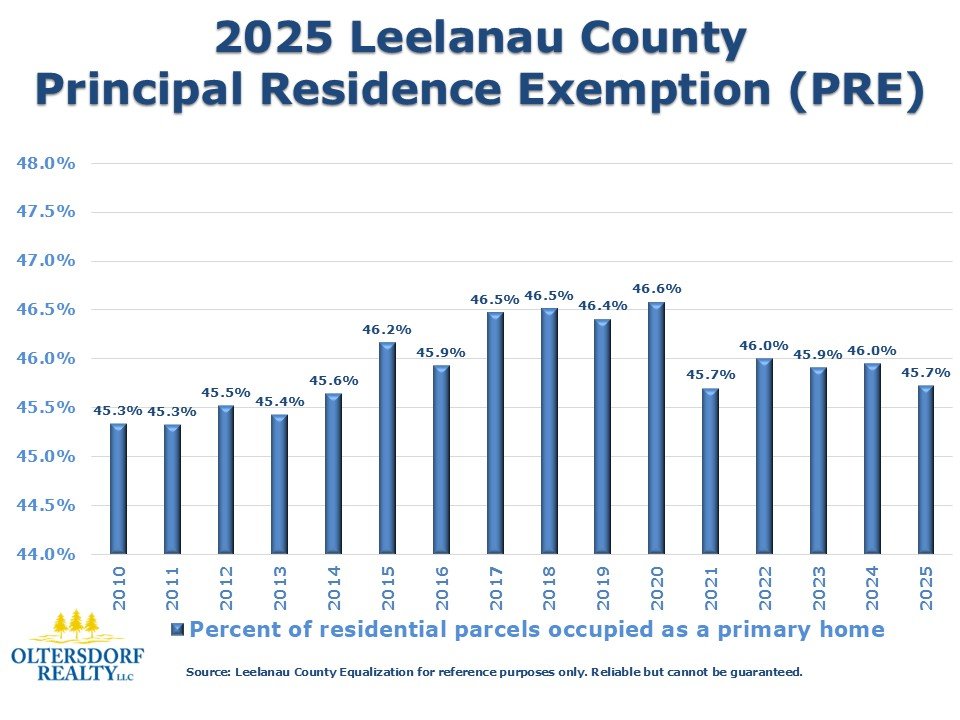
Leelanau County Principal Residence Exemption Trends (2010–2025): What the Data Really Tells Us

Leelanau County Principal Residence Exemption Trends (2010–2025): What the Data Really Tells Us

If you’re trying to understand who actually lives in Leelanau County—versus who owns vacation or investment property—the Principal Residence Exemption (PRE) is one of the most important data points available.

The chart above shows the percentage of residential parcels occupied as a primary home in Leelanau County from 2010 through 2025, based on Equalization Department data. And while the year-to-year changes may look small, the long-term trend tells a bigger story about housing pressure, second-home ownership, and inventory constraints.

What Is the Principal Residence Exemption (PRE)?

In Michigan, a Principal Residence Exemption indicates that a property is the owner’s primary residence. Homes with a PRE are typically occupied year-round by local residents, while parcels without a PRE are often:

  • Seasonal or vacation homes

  • Short-term or long-term rentals

  • Investment properties

  • Second homes owned by out-of-area buyers

Tracking PRE percentages is one of the best ways to measure how much of a community’s housing stock is truly serving full-time residents.

Key Takeaways from the 2010–2025 Leelanau County PRE Data

1. Less than half of all parcels are primary residences
Throughout the entire 15-year period shown, the PRE rate stays in a narrow range—roughly 45% to 47%. That means a majority of residential parcels in Leelanau County are not occupied full-time.

This is a defining characteristic of the local real estate market and a major reason inventory remains tight even when sales slow.

2. The peak occurred around 2017–2020
PRE percentages climbed steadily from 2010 and peaked around 2017–2020, topping out near 46.6%. This period coincides with:

  • Strong in-migration before and during the early COVID years

  • Buyers converting second homes into primary residences

  • Increased remote work flexibility

3. A post-2020 pullback reflects market reality
After 2020, the PRE percentage dips slightly and stabilizes again in the mid-45% range. This suggests:

  • Continued demand for seasonal and second homes

  • Investors and lifestyle buyers remaining active

  • Fewer homes converting to full-time residences than many expect

Despite record-setting sales activity earlier this decade, Leelanau County has not shifted into a majority full-time resident market.

Why PRE Trends Matter for Buyers and Sellers

For Buyers:
Low PRE percentages mean you’re competing in a market with:

  • Fewer owner-occupied listings

  • Higher competition for year-round homes

  • Zoning and rental rules that matter more than in typical markets

Understanding PRE data helps buyers set realistic expectations and make smarter offers.

For Sellers:
Homes that work well as primary residences often attract a different buyer pool than vacation or rental-focused properties. Knowing where demand actually comes from can directly affect pricing, timing, and marketing strategy.

For Policy and Long-Term Planning:
PRE data also plays a role in conversations about workforce housing, school enrollment, and local services—topics that continue to shape Leelanau County’s future.

Bottom Line

Leelanau County’s real estate market is not driven primarily by year-round residents—and the data proves it. For more than a decade, over half of all residential parcels have been non-primary residences, and that reality continues in 2025.

Anyone buying, selling, or investing here needs to understand this dynamic. It impacts values, inventory, negotiations, and long-term appreciation.

Want Local Data That Actually Matters?

I regularly analyze Leelanau County real estate trends, including sales, financing, cash purchases, and housing use patterns like PRE. If you want data-driven insight instead of national headlines, you’re in the right place.

Need Expert Real Estate Advice? Contact Jonathan Oltersdorf Today!

For personalized insights into Leelanau County real estate, reach out to Jonathan Oltersdorf at Oltersdorf Realty, LLC.

📞 Office Phone: 231-271-7777
📧 Email: jonathan@oltersdorf.com
🌐 Website: www.oltersdorf.com
Leelanau County Home Prices vs the S&P 500 (2010–2025): Real Estate as a Long-Term Investment

Leelanau County Home Prices vs the S&P 500 (2010–2025): Real Estate as a Long-Term Investment

The chart above compares Leelanau County home prices—both average and median sales prices—against the S&P 500 Index year-end values from 2010 through 2025.

Why compare housing to the stock market? Because many buyers and sellers ask the same question every year:

“Would I be better off putting my money in the market instead of real estate?”
OR
”Should I buy real estate from my stock market profits?”

This data-driven comparison helps answer that—specifically for Leelanau County, not the national averages that rarely reflect our local reality.

What the Chart Shows

This chart tracks three key metrics over 15 years:

  • Average Leelanau County sales price

  • Median Leelanau County sales price

  • S&P 500 Index year-end price

While these numbers measure different asset classes, they reveal how local real estate has performed alongside one of the most commonly referenced investment benchmarks.

Key Takeaways from 2010–2025

1. Leelanau County home prices show steady, long-term appreciation

From 2010 to 2025, both average and median home prices in Leelanau County trend consistently upward. Growth wasn’t perfectly smooth—no real asset ever is—but the long-term direction is clear.

This steady climb reflects:

  • Limited inventory

  • Strong second-home and lifestyle demand

  • A market less tied to short-term economic shocks

Real estate here behaves more like a scarcity asset than a speculative one.

2. Housing volatility is meaningfully different than the stock market

The S&P 500 experiences sharper rises and drops, including:

  • Rapid growth years

  • Short-term pullbacks

  • Emotional reaction cycles

Leelanau County home prices, by contrast, show less volatility and fewer dramatic swings.

That matters for:

  • Risk-averse investors

  • Homeowners focused on long-term equity

  • Buyers prioritizing stability over short-term gains

  • Real estate as an inflation hedge

Housing doesn’t spike like stocks—but it also doesn’t whipsaw the same way.

3. The 2020–2022 period changed the trajectory

Both asset classes accelerated after 2020, but local housing saw:

  • A surge in demand from remote workers

  • Increased migration from urban markets

  • Buyers converting second homes into primary residences

While the stock market experienced notable ups and downs after that surge, Leelanau County home values held their ground, reinforcing the market’s structural demand.

4. Median vs. average price trends matter

The median price rising alongside the average price signals broad-based appreciation—not just growth driven by luxury sales.

That tells us:

  • Appreciation wasn’t limited to top-tier waterfront homes

  • Demand pushed through multiple price brackets

  • The market strength wasn’t isolated to a few outliers

This is a key indicator of healthy price growth.

What This Means for Buyers, Sellers, and Investors

For Buyers:
Trying to time the Leelanau County market like stocks rarely works. Long-term buyers who focus on lifestyle, use, and holding power tend to benefit most.

For Sellers:
Price support here is structural, not speculative. Even during slower sales cycles, values don’t unwind the way overheated metro markets sometimes do.

For Investors:
Leelanau County real estate behaves less like a trading asset and more like a long-duration hold—with appreciation driven by geography, zoning, and limited supply.

Leelanau County Is Not a Wall Street Trade

This comparison makes one thing clear:
Leelanau County housing doesn’t move like the S&P 500—and that’s the point.

Stocks react quickly. Real estate here moves deliberately. And for many owners, that slower, steadier path has proven just as powerful over time—especially when paired with use, rental income, or tax advantages.

Want Local Market Data That Actually Applies Here?

I regularly analyze Leelanau County home prices, sales trends, financing patterns, and long-term market signals using local MLS and county data—not national headlines.

If you’re buying, selling, or simply trying to understand where this market fits in a bigger financial picture, local data beats generic advice every time.

Need Expert Real Estate Advice? Contact Jonathan Oltersdorf Today!

For personalized insights into Leelanau County real estate, reach out to Jonathan Oltersdorf at Oltersdorf Realty, LLC.

📞 Office Phone: 231-271-7777
📧 Email: jonathan@oltersdorf.com
🌐 Website: www.oltersdorf.com
2025–2026 Leelanau County Home Inventory: Why Low Supply Is Still Defining the Market

2025–2026 Leelanau County Home Inventory:
Why Low Supply Is Still Defining the Market

By Jonathan Oltersdorf, Leelanau County Realtor

Leelanau County’s real estate market continues to be defined by one word: scarcity.

As of January 29, 2026, there are just 55 available (non pending) homes for sale in the entire county, translating to roughly a ±2-month supply of inventory. To put that in perspective, a balanced real estate market typically sits closer to 5–6 months of supply. Leelanau County isn’t even in the same zip code as balanced in the winter months.

A Long-Term Look at Leelanau County Housing Inventory

The chart above shows Leelanau County home inventory trends from 2010 through early 2026, highlighting both summer peaks and winter lows. The contrast is stark:

  • 2009–2011: Inventory ranged from a 2–3 year supply, driven by the Great Recession.

  • 2012–2019: Gradual tightening, but still seasonal and manageable.

  • 2020–Present: A structural shift to historically low inventory levels post Covid.

Even during peak summer seasons in recent years, the county has struggled to exceed a 6-month supply, and winter inventory routinely collapses into ultra-low territory.

What a ±2 Month Supply Really Means

A ±2 month supply isn’t just “low”—it’s seller-dominant territory.

In practical terms, this means:

  • Well-priced homes sell quickly

  • Buyers face limited choices

  • Multiple-offer situations remain common in desirable locations

  • Pricing stays firm, even when interest rates fluctuate

Low inventory also explains why Leelanau County home values have remained resilient while other markets across the country experience softening.

Why Inventory Hasn’t Rebounded

Contrary to popular belief, this isn’t just a post-COVID hangover. Several long-term factors are keeping inventory tight:

  1. Low turnover: Many homeowners are locked into historically low interest rates and won’t sell unless they have to.

  2. Limited new construction: Zoning, land constraints, and infrastructure limit large-scale development.

  3. Second-home demand: Leelanau County continues to attract out-of-area buyers seeking lifestyle properties.

  4. Strong cash presence: Cash buyers reduce reliance on financing cycles, stabilizing demand.

What This Means for Buyers in 2026

For buyers, today’s market requires strategy, patience, and local expertise. Waiting for a flood of inventory hasn’t worked—and history suggests it may not.

Smart buyers are:

  • Watching micro-markets (neighborhoods, townships, waterfront vs inland)

  • Acting decisively when the right property appears

  • Understanding realistic pricing instead of relying on national headlines

What This Means for Sellers

If you’ve considered selling but assumed the market “must have cooled,” the inventory numbers tell a different story.

With only 55 active listings county-wide, sellers who price correctly still benefit from:

  • Limited competition

  • Strong buyer demand

  • Shorter days on market relative to national averages

The Bottom Line on Leelanau County Housing Inventory

Leelanau County is no longer cycling between “hot” and “cold” markets—it has entered a low-inventory era. Seasonal fluctuations still exist, but the overall supply trend remains historically tight.

If you’re buying or selling in Suttons Bay, Leland, Glen Arbor, Northport, or anywhere in Leelanau County, decisions today should be based on local inventory data, not national real estate narratives.

About the Author

Jonathan Oltersdorf is a Leelanau County Realtor with Oltersdorf Realty, specializing in residential homes, waterfront properties, and vacant land throughout Leelanau County and Northern Michigan. Jonathan provides clear, data-driven market analysis to help buyers and sellers make confident real estate decisions. Jonathan is a lifelong Leelanau County local that attended Suttons Bay Schools.

Based on data provided by Northern Great Lakes REALTORS® MLS. Reliable but not guaranteed. Fractional ownership excluded.

Need Expert Real Estate Advice? Contact Jonathan Oltersdorf Today!

For personalized insights into Leelanau County real estate, reach out to Jonathan Oltersdorf at Oltersdorf Realty, LLC.

📞 Office Phone: 231-271-7777
📧 Email: jonathan@oltersdorf.com
🌐 Website: www.oltersdorf.com
Leelanau County Home Sales 2025: How 375 Buyers Purchased—Cash vs Financing

Leelanau County Single Family Home Sales 2025:
How 375 Buyers Purchased - Cash vs Financing

2025 Leelanau County Homebuyers: Cash vs. Financing Trends Explained

If you’re buying or selling real estate in Leelanau County, one question to keep an eye on in today’s market:

Are buyers paying cash, or are they financing?

The short answer for 2025: both—but financing is back in the driver’s seat.

2025 Leelanau County Home Sales Breakdown

Based on data from the Northern Great Lakes Realtors MLS, here’s how 375 total sales in Leelanau County in 2025 break down:

  • 55% Financing

  • 45% Cash Purchases

That’s a meaningful shift, especially when compared to 2024, when 44% of sales were cash and 2023 when 50% of sales were cash. Cash buyers didn’t disappear—but financed buyers are clearly reasserting themselves.

In other words:
💰 Cash is still powerful.
🏦 But mortgages are very much back in play.

What’s Driving Financing Back Into the Market?

1. Interest Rates Have Stabilized

The average 30-year fixed mortgage rate in 2025 is approximately 6.60%. While that’s higher than pandemic-era lows, buyers have adjusted expectations. The shock is gone. Normal decision-making has returned.

Translation: buyers aren’t waiting for “perfect” rates anymore. They’re moving forward.

2. Pent-Up Buyer Demand

Many financed buyers sat on the sidelines in 2023–2024, especially first-time and move-up buyers. By 2025, lifestyle needs (schools, downsizing, second homes) are outweighing rate anxiety.

People still need houses—even in Northern Michigan.

3. Leelanau County’s Buyer Pool Is Evolving

Leelanau County continues to attract:

  • Primary-residence buyers and 2nd home buyers

  • Professionals relocating from downstate

  • Buyers selling higher-priced homes elsewhere and financing strategically

Not every buyer wants to pay cash—even if they could.

What This Means for Sellers in Leelanau County

Cash offers still matter—but they’re no longer the whole story.

If you’re selling:

  • Expect a broader buyer pool

  • Well-priced homes will attract both cash and financed buyers

  • Clean listings, realistic pricing, and strong negotiation matter more than “cash only” thinking

Sellers who automatically dismiss financed buyers in 2025 may leave money—or better terms—on the table.

What This Means for Buyers

If you’re financing a home purchase in Leelanau County, here’s the good news:

  • You are not the minority

  • Sellers are increasingly open to financed offers

  • Strong pre-approvals and clean terms matter more than rate obsession

Cash buyers still have leverage—but financed buyers are competing successfully every day.

Bottom Line: A Healthier, More Balanced Market

The 2025 Leelanau County real estate market shows signs of normalization:

  • Financing dominates at 55% of sales

  • Cash remains strong at 45%

  • Total sales increased to 375 transactions

  • Buyers and sellers are adapting—not freezing

This balance is exactly what a sustainable market looks like.

If you’re thinking about buying or selling in Leelanau County or Traverse City, understanding how buyers are purchasing is just as important as knowing what homes are selling for.

Need Expert Real Estate Advice? Contact Jonathan Oltersdorf Today!

For personalized insights into Leelanau County real estate, reach out to Jonathan Oltersdorf at Oltersdorf Realty, LLC.

📞 Office Phone: 231-271-7777
📧 Email: jonathan@oltersdorf.com
🌐 Website: www.oltersdorf.com
Where did 2025 Leelanau County Homebuyers Come From?

Where did 2025 Leelanau County
Homebuyers Come From?

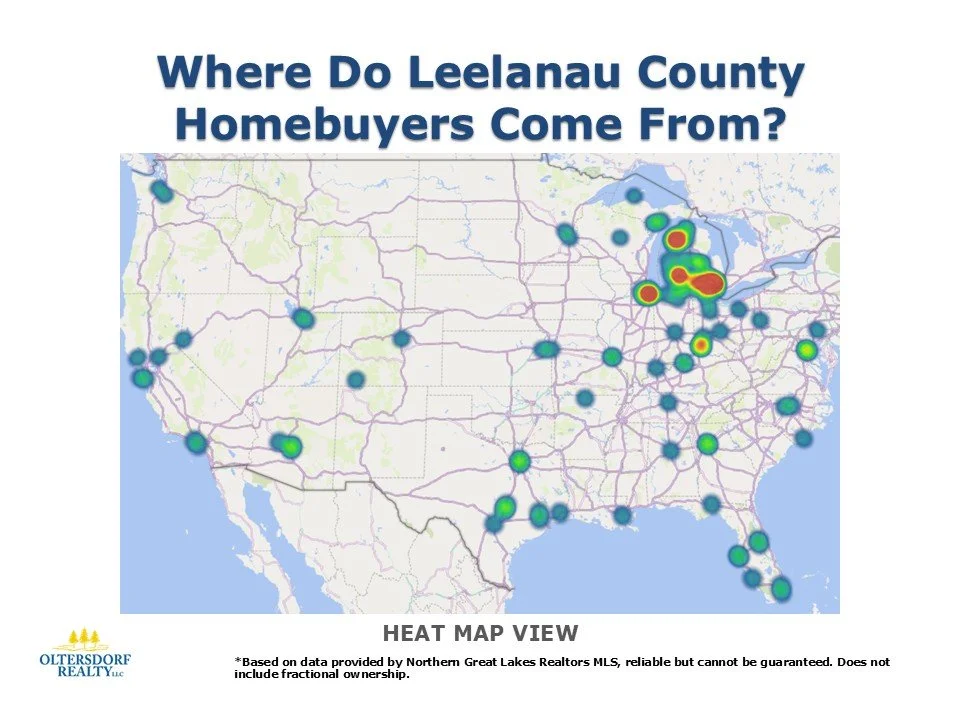
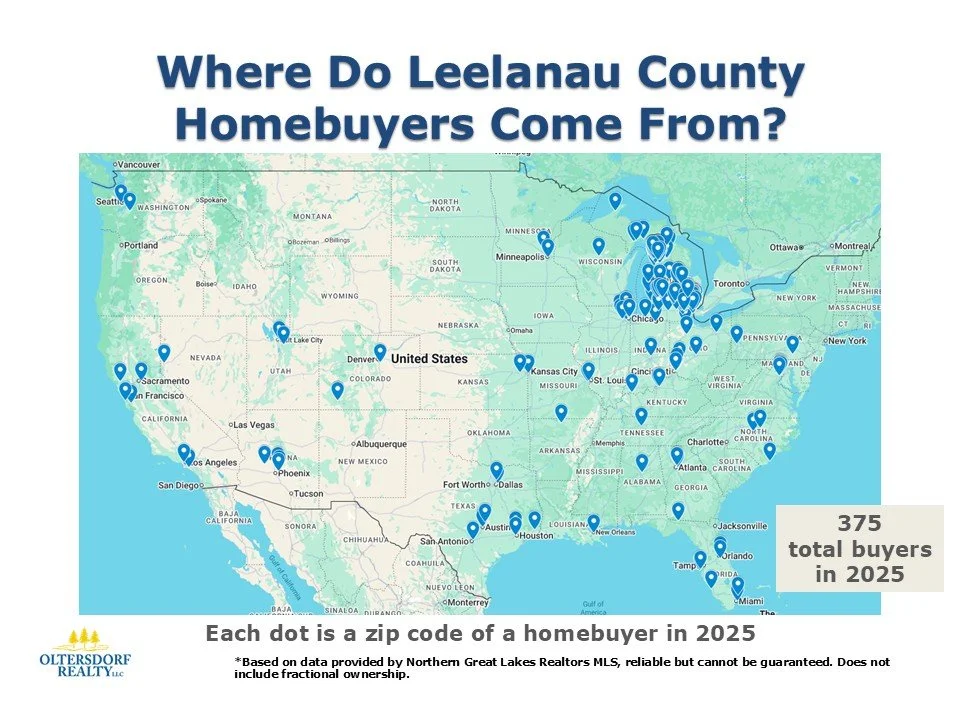
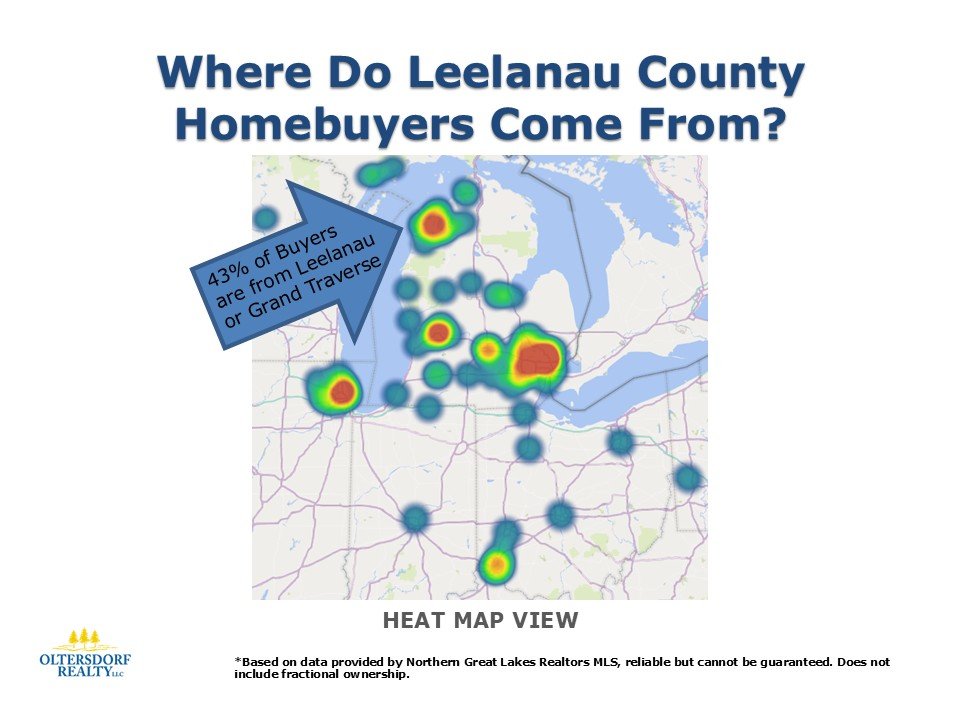
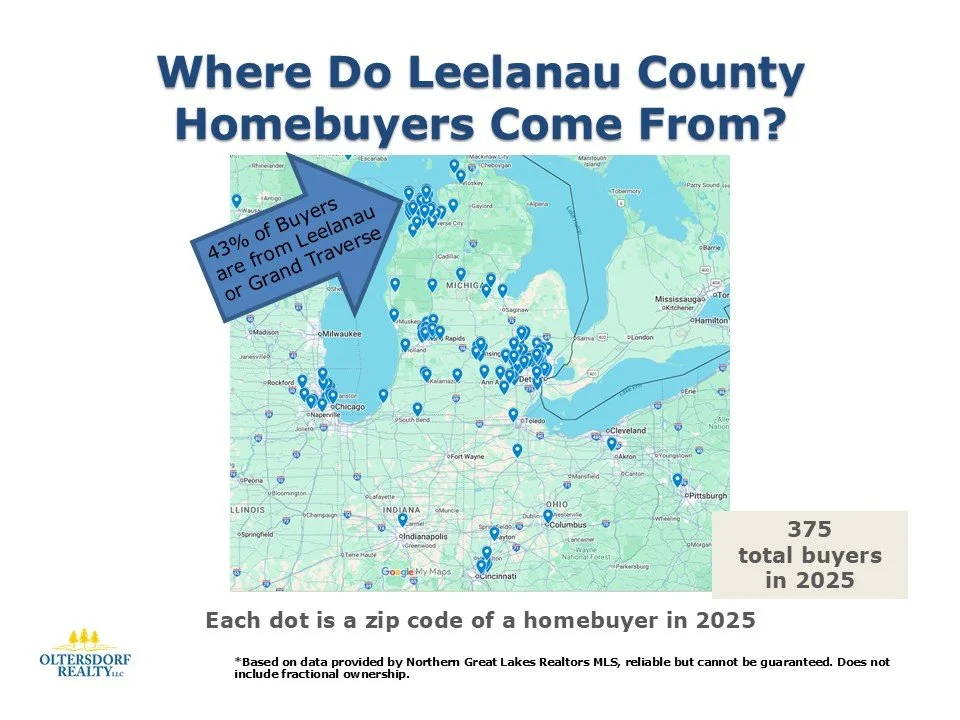
Understanding where Leelanau County homebuyers are coming from is key to understanding market demand, pricing pressure, and future trends. Based on Northern Great Lakes Realtors® MLS data, the visuals above tell a clear story: Leelanau County real estate is no longer a mostly local market — it’s a regional and national one.

Below is a breakdown of what the data shows and why it matters if you’re thinking about buying or selling property in Leelanau County.

Leelanau County Buyers: A National Footprint

The heat map shows buyer zip codes spread across the entire United States, with heavy concentrations in:

  • Michigan (especially Southeast Michigan)

  • Illinois (Chicago metro area)

  • Ohio, Indiana, and Wisconsin

  • Secondary pockets along the East Coast, Texas, Florida, and the West Coast

This confirms what many sellers already feel during showings: Leelanau County attracts out-of-area buyers who are willing to travel, compete, and pay for lifestyle.

Northern Michigan is no longer a secret — it’s a destination.

Local Buyers Are Shrinking as a Share of the Market

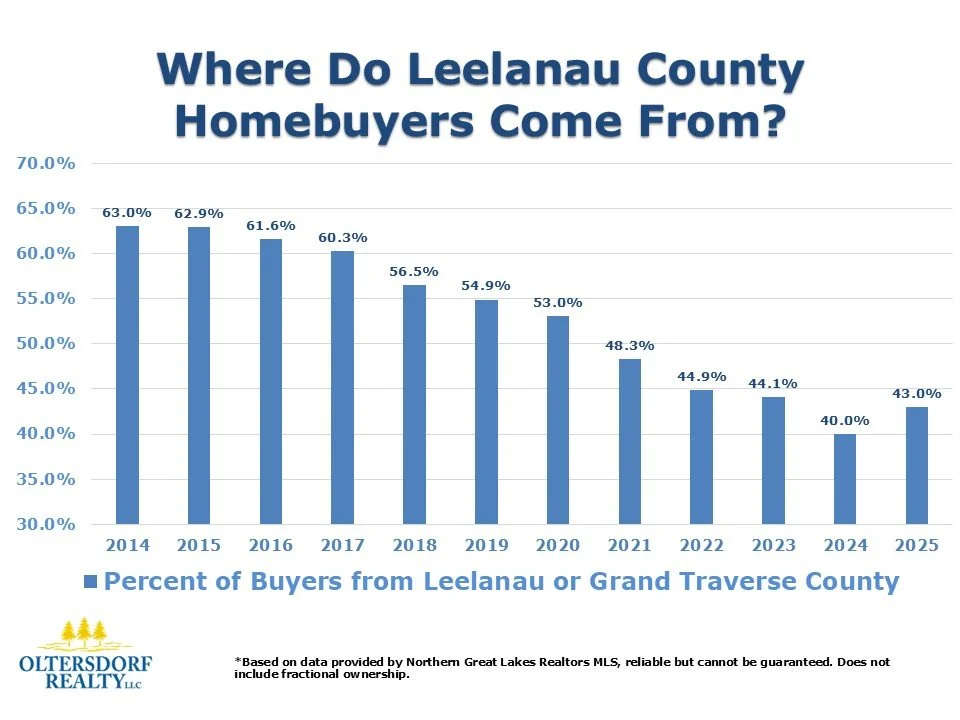
The bar chart highlights a long-term trend that matters a lot.

Percent of Buyers From Leelanau or Grand Traverse County:

  • 2014: 63.0%

  • 2016: 61.6%

  • 2018: 56.5%

  • 2020: 53.0%

  • 2021: 48.3%

  • 2023: 44.1%

  • 2024: 40.0%

  • 2025: 43.0%

While 2025 shows a small rebound, the big picture is clear: local buyers now represent less than half of the market.

This shift has major implications:

  • More cash buyers

  • Fewer contingency-driven offers

  • Stronger demand for waterfront, second homes, and short-term rental-capable properties

2025 Buyer Breakdown: The Numbers

  • 375 total buyers in 2025

  • 43% from Leelanau or Grand Traverse County

  • 57% from outside the local area

Each dot on the Michigan map represents a unique buyer zip code from 2025, reinforcing how geographically diverse demand has become.

This isn’t just tourism interest — these are people putting capital into Leelanau County real estate.

Why This Matters for Sellers

If you’re selling a home or land in Leelanau County, this data should shape your strategy.

Out-of-area buyers:

  • Rely heavily on online listings, photos, video, and data

  • Are more emotional about lifestyle and views than price-per-square-foot

  • Often make faster decisions

That means:

  • Professional marketing matters

  • Overpricing gets exposed quickly

  • Unique properties perform best when positioned correctly

The market rewards sellers who understand who the buyer actually is.

What This Means for Buyers

If you’re a local buyer, the competition isn’t your neighbor — it’s often someone from:

  • Metro Detroit

  • Chicago

  • Cincinnati or Columbus

  • Out-of-state buyers seeking second homes or retirement properties

Winning in this market often requires:

  • Strong financing or cash

  • Clean offers

  • Decisiveness

Understanding buyer origins helps explain why well-priced homes move quickly — even in shifting market conditions.

The Big Picture: Leelanau County Is a Lifestyle Market

The takeaway is simple:

Leelanau County is no longer driven primarily by local demand. It’s driven by lifestyle migration, remote work flexibility, and long-term wealth preservation.

That’s a fundamentally different market than it was 10 years ago — and it’s why smart pricing, timing, and strategy matter more than ever.

Data based on information provided by Northern Great Lakes Realtors® MLS. Reliable but not guaranteed. Does not include fractional ownership.

Need Expert Real Estate Advice? Contact Jonathan Oltersdorf Today!

For personalized insights into Leelanau County real estate, reach out to Jonathan Oltersdorf at Oltersdorf Realty, LLC.

📞 Office Phone: 231-271-7777
📧 Email: jonathan@oltersdorf.com
🌐 Website: www.oltersdorf.com
2025 Leelanau County Real Estate Market Update: Prices Rise, Sales Volume Surges

2025 Leelanau County Real Estate Market Update:
Prices Rise, Sales Volume Surges

If you’ve been waiting for Leelanau County real estate to “cool off,” 2025 politely declined. Prices rose, sales volume surged, and more homes sold than the year before. Using figures from the Northern Great Lakes Realtors® MLS, here’s what actually happened in the Leelanau County residential real estate market in 2025 and what it means moving forward.

Total Residential Sales Volume Climbs Sharply

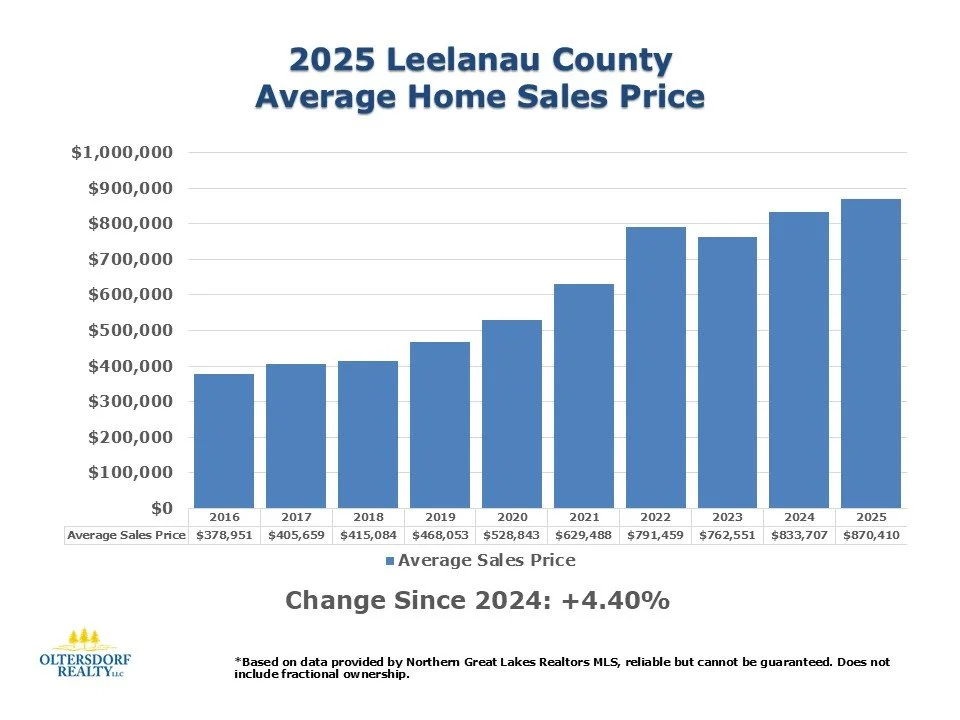
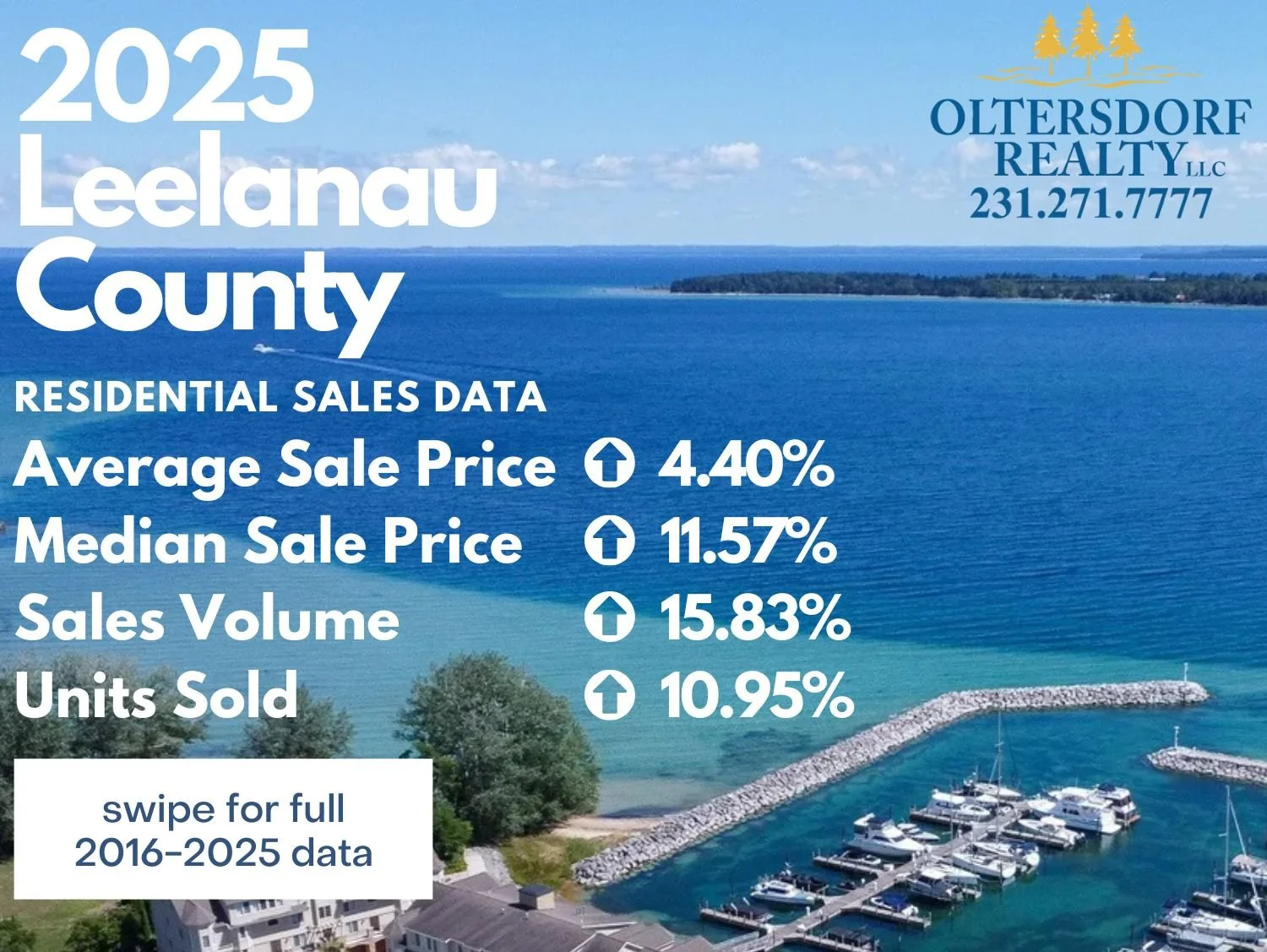
Total residential sales volume in Leelanau County reached $326,403,770 in 2025, a +15.83% increase over 2024.

That kind of growth doesn’t happen by accident, especially in a higher-rate environment. It reflects strong demand, confident buyers, and sellers successfully closing at higher price points.

Bottom line: capital is still flowing into Leelanau County real estate.

Total Homes Sold Increased by Nearly 11%

This is the stat that cuts through the noise.

  • 2024 total homes sold: 338

  • 2025 total homes sold: 375

  • Year-over-year change: +10.95%

More homes sold and higher prices means demand isn’t just holding—it’s expanding.

Why this matters:

  • Buyers weren’t just browsing—they were committing.

  • Inventory that hit the market moved.

  • The increase in sales volume wasn’t driven only by luxury closings.

In short: this was real market activity, not statistical inflation.

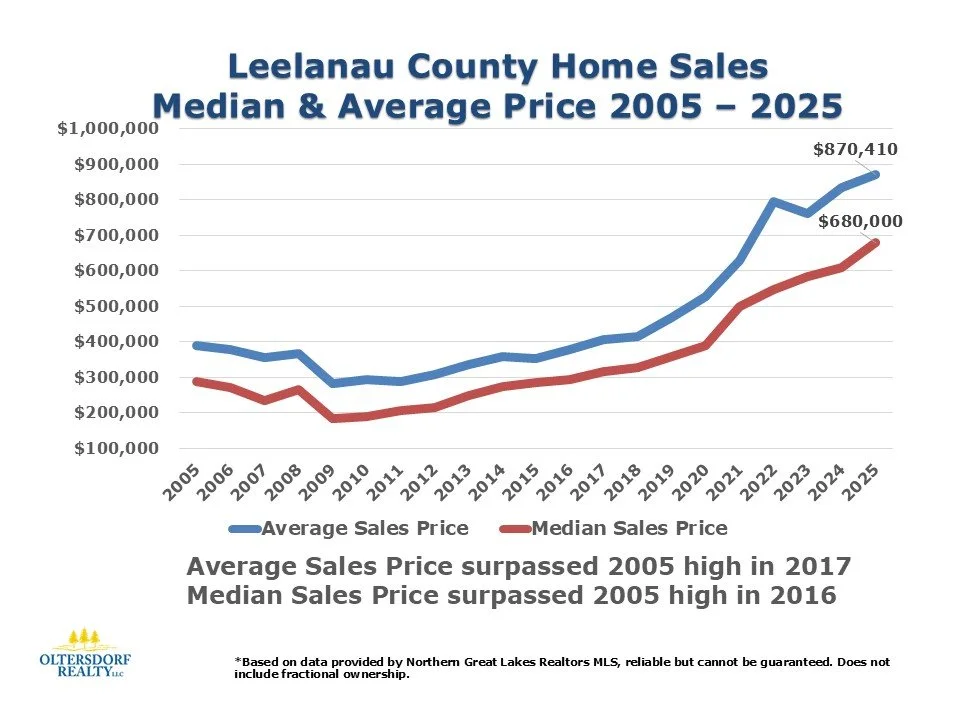
Median Home Price Reaches $680,000

The median home sales price rose to $680,000 in 2025, an 11.57% increase year-over-year.

Median price tells us what the typical Leelanau County home is doing, and this confirms price strength across the market—not just at the high end.

What it signals:

  • Strong competition for well-priced homes

  • Continued upward pressure from limited inventory

  • Sellers rewarded for correct pricing and preparation

Leelanau County remains a supply-constrained market, and the data shows it.

Average Home Price Shows Healthy, Slower Growth

The average home sales price increased to $870,410, up 4.40% from 2024.

This slightly slower growth compared to the median price is actually good news.

Translation:

  • Fewer extreme outlier sales skewing the numbers

  • A more balanced mix of primary, second-home, and luxury transactions

  • A maturing, stabilizing market—not a declining one

Stability at elevated price levels is a sign of confidence, not weakness.

What This Meant for Buyers and Sellers in 2025

Sellers:

  • Demand is proven, not speculative.

  • Homes are selling—375 of them, to be exact.

  • Pricing strategy matters more than ever.

Overpricing will get noticed faster than it used to. Buyers are motivated, but they’re not reckless.

Buyers:

  • Waiting for a major pullback in Leelanau County has historically been a losing bet.

  • Negotiation opportunities exist, especially on stale or improperly priced listings.

  • Quality homes continue to attract competition.

The smartest buyers in 2025 weren’t timing the market—they were choosing the right property.

Why Leelanau County Continues to Outperform

Leelanau County’s long-term strength comes from fundamentals that don’t change quickly:

  • Limited supply and strict zoning

  • Persistent second-home and cash-buyer demand

  • Lifestyle-driven purchases, not short-term speculation

  • Buyers thinking in decades, not rate cycles

2025 reinforced what locals already know: this market plays the long game.

Thinking About Buying or Selling in Leelanau County?

Market stats are useful—but strategy is everything. Whether you’re preparing to sell, evaluating timing, or trying to buy without overpaying, local insight matters.

If you want a straightforward, data-driven read on your situation (no sugarcoating, no national-portal nonsense), feel free to reach out.

Data based on information from the Northern Great Lakes Realtors® MLS. Reliable but not guaranteed. Does not include fractional ownership.

Need Expert Real Estate Advice? Contact Jonathan Oltersdorf Today!

For personalized insights into Leelanau County real estate, reach out to Jonathan Oltersdorf at Oltersdorf Realty, LLC.

📞 Office Phone: 231-271-7777
📧 Email: jonathan@oltersdorf.com
🌐 Website: www.oltersdorf.com
2025 Grand Traverse County Real Estate Market Report: Year-End Home Sales Data & Trends

2025 Grand Traverse County Real Estate Market Report: Year-End Home Sales Data & Trends

2025 Traverse City Real Estate Market Report: Key Statistics and Trends in Grand Traverse County

Traverse City, nestled along the stunning shores of Grand Traverse Bay in Michigan, continues to be a sought-after destination for homebuyers seeking a blend of natural beauty, outdoor recreation, and vibrant community life. As we move through 2026, the 2025 residential real estate data for Grand Traverse County provides valuable insights for buyers, sellers, and investors.

Based on data from the Northern Great Lakes Realtors MLS (compiled by Oltersdorf Realty), the market showed signs of recovery in sales activity despite slight price corrections.

Overview of 2025 Grand Traverse County Home Sales Statistics

In 2025, Grand Traverse County's residential real estate market demonstrated resilience. While home prices experienced minor declines from 2024 peaks, the number of units sold and overall sales volume rebounded notably.

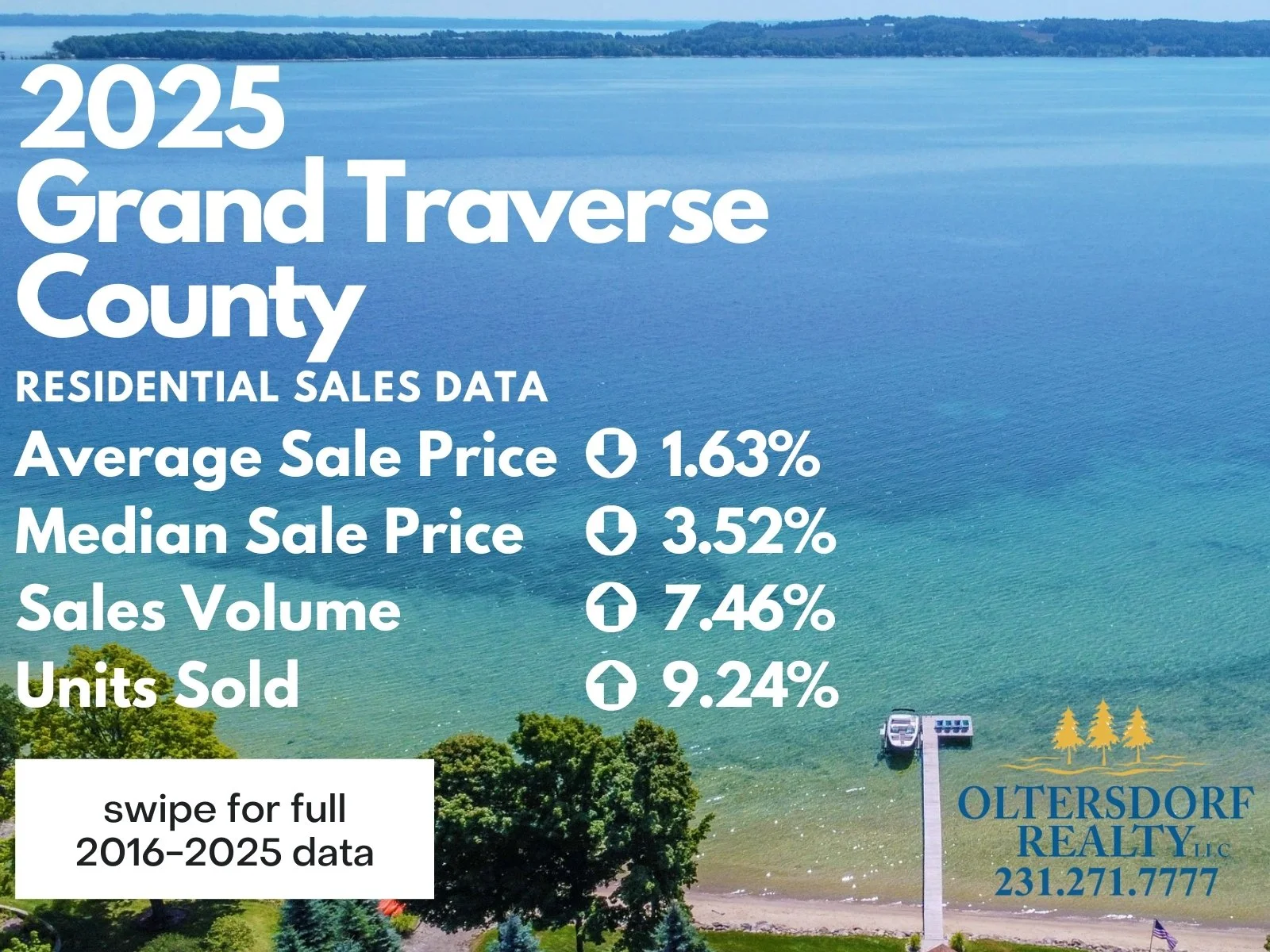
Year-over-Year Changes (2024 to 2025):

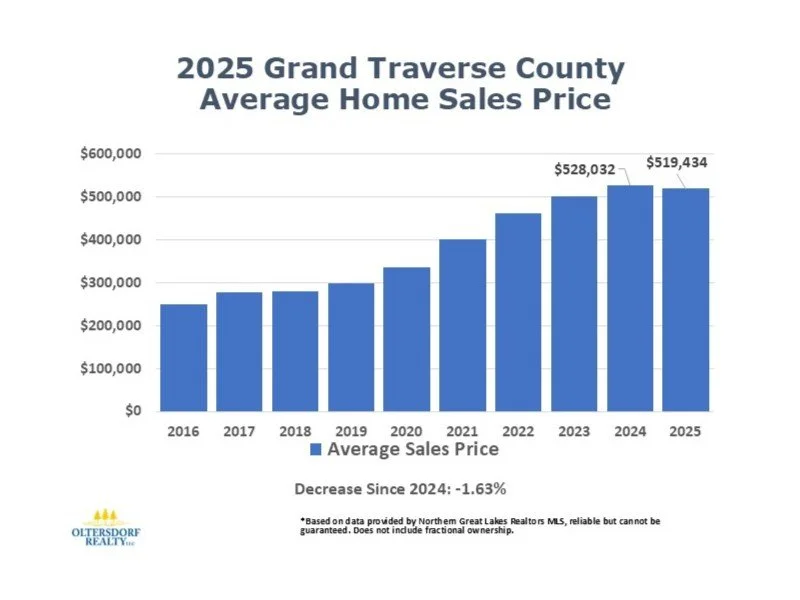
  • Average Sale Price: $528,032 → $519,434 (-1.63%)
  • Median Sale Price: $420,000 → $405,223 (-3.52%)
  • Sales Volume: ~$698M → $749,023,516 (+7.46%)
  • Units Sold: 1,320 → 1,442 (+9.24%)

Data excludes fractional ownership and is based on reliable MLS sources.

Compared to Michigan statewide trends (median home price up 4.7% to $267,600 in late 2025) and national figures (U.S. median existing-home price up 1.7% to $414,400), Grand Traverse County prices remain significantly higher, reflecting its premium lakeside location.

Residential Units Sold: A Strong Rebound

Units sold increased 9.24% from 1,320 in 2024 to 1,442 in 2025 — the strongest annual sales volume since 2021.

10-Year Trend (2016–2025):

  • 2016: 1,741
  • 2017: 1,639
  • 2018: 1,639
  • 2019: 1,805 (peak)
  • 2020: 1,713
  • 2021: 1,732
  • 2022: 1,470
  • 2023: 1,311
  • 2024: 1,320
  • 2025: 1,442

This uptick suggests growing buyer confidence and increased market activity in Northern Michigan.

Total Sales Volume: Healthy Growth

Total residential sales volume reached $749,023,516 in 2025, a solid +7.46% increase from 2024 — despite the modest price softening.

Higher transaction volume more than offset the slight decline in average and median prices.

Average & Median Home Prices: Slight Cooling

  • Average Sale Price 2025: $519,434 (-1.63% from 2024)
  • Median Sale Price 2025: $405,223 (-3.52% from 2024)

Long-term perspective (2004–2025): Both average and median prices have more than doubled since the early 2000s, showing strong long-term appreciation even with the 2025 correction.

This slight price softening creates opportunities for buyers while the market remains fundamentally strong.

What These Trends Mean for 2026 and Beyond

The 2025 data indicates a rebalancing Traverse City housing market:

  • More homes are selling
  • Prices have moderated slightly
  • Inventory is improving regionally
  • Buyer activity is picking up

With national forecasts predicting modest price growth (2–4%) and potentially lower mortgage rates, Grand Traverse County could see continued positive momentum in 2026.

Key factors to watch:

  • Rising inventory across Michigan
  • Strong demand for lifestyle locations like Traverse City
  • Stable local economy (tourism, healthcare, remote work appeal)

Whether you're looking to buy your dream home on the bay, sell your current property, or invest in Northern Michigan real estate, 2026 appears to offer promising opportunities.

For personalized guidance on Traverse City homes, waterfront properties, or the latest Grand Traverse County market updates, contact a local expert today.

Data source: Northern Great Lakes Realtors MLS, compiled by Oltersdorf Realty. Figures are reliable but not guaranteed.

This report is based on verified MLS data from the Northern Michigan Realtors. Note that undisclosed home sales and fractional ownership transactions are excluded to maintain data accuracy.

Need Expert Real Estate Advice? Contact Jonathan Oltersdorf Today!

For personalized insights into Grand Traverse County real estate, reach out to Jonathan Oltersdorf at Oltersdorf Realty, LLC.

📞 Office Phone: 231-271-7777
📧 Email: jonathan@oltersdorf.com
🌐 Website: www.oltersdorf.com

Geography of Choice in 2020s America: Traverse City & Leelanau County

The Geography of Choice in 2020s America: What a Recent Domestic Migration Map Reveals — And Why Traverse City and Leelanau County, MI Are Winning Big

National Migration Hotspots and Cold Spots

  • Big winners in dark green: The Upper Rockies (+6.0% of regional population), Greater Ozarks (+3.5%), Texas Triangle (+3.5%), Southern Coastal Plain (+7.1%), and the Northwoods (+3.3% with 56,000 net new residents).

  • The map outlines the Northwoods (Laurentian Mixed Forest Province) stretching across northern Minnesota, Wisconsin, the Upper Peninsula of Michigan, and into the northern Lower Peninsula — a sparsely populated, forested region standing out with consistent green shading amid much of the rural Midwest's neutral or purple tones.

  • Major losers in purple: California (1.47 million net loss, -3.7%), the Mississippi Delta (-5.0%), and parts of the Great Plains.

The map emphasizes that migration favors scenic, nature-rich areas with lower costs and outdoor appeal — often rural or small-town spots boosted by remote work.Why the Northwoods — Including Northern Michigan — Are Attracting New Residents. The Northwoods region, including much of Northern Michigan, bucks broader Midwest trends with positive net domestic migration. This aligns with real-world data: Michigan's rural counties (especially in the northwest) saw population growth from 2020-2024 driven by domestic in-migration, offsetting natural decrease. Areas like Traverse City and surrounding counties have benefited from inflows of remote workers, retirees, and families escaping high costs, extreme heat in places like Texas/Florida, or urban pressures elsewhere.Recent reports note people moving into the Traverse City area from southern states, drawn by four-season beauty, community, and relative affordability compared to coastal hotspots.Traverse City and Leelanau County: A Prime Example of "Geography of Choice"Nestled in the heart of the Northwoods ecoregion along Lake Michigan, Traverse City, MI, and Leelanau County embody why people are choosing these areas. The region boasts stunning natural features, a thriving local economy (wine, cherries, tourism), and a peaceful lifestyle that's increasingly appealing in the 2020s.

Why Move to Traverse City or Leelanau County, MI?

  • Natural beauty — Pristine lakes, dunes, forests, and trails.

  • Quality of life — Four seasons, farm-to-table scene, wineries, and small-town vibe.

  • Migration momentum — Positive domestic inflows, especially post-2020, as people seek cooler climates and space.

  • Economic perks — Growing opportunities in tourism, remote work, and agriculture.

If you're considering a move to Northern Michigan, Traverse City and Leelanau County stand out as top destinations in America's shifting "Geography of Choice." The 2020-2024 migration map proves it: people are choosing places like ours for the lifestyle they offer.Have you noticed more out-of-state plates around town?

2024 Grand Traverse County Real Estate Market Report: Year-End Home Sales Data & Trends

2024 Grand Traverse County Real Estate Market Report: Year-End Home Sales Data & Trends

Looking for the latest 2024 Grand Traverse County real estate market trends? This comprehensive year-end home sales report provides in-depth insights into Traverse City home sales, pricing trends, and real estate market performance. Explore historical sales data, compare pricing changes, and discover what’s driving the Northern Michigan housing market.

2024 Grand Traverse County Home Sales Data & Market Trends

The 2024 real estate market in Grand Traverse County saw notable shifts in pricing and sales volume. Below, we break down the key data points for home sales between January 1, 2024, and December 31, 2024, while comparing trends from the past decade (2015-2023). This data includes sales across Acme, Blair, East Bay, Fife Lake, Garfield, Grant, Green Lake, Long Lake, Mayfield, Paradise, Peninsula, Union, Whitewater, and the City of Traverse City.

Key 2024 Grand Traverse County Home Sales Statistics:

  • Total Homes Sold: +0.38% Increase (compared to 2023)

  • Total Sales Volume: +6.04% Increase

  • Average Home Sales Price: +5.64% Increase

  • Median Home Sales Price: +6.04% Increase

Traverse City & Grand Traverse County Housing Market Insights

The Traverse City real estate market has remained strong, with steady growth in home values and increased buyer demand. Rising home prices in 2024 reflect market stability, while inventory levels continue to shape the housing landscape. Whether you’re a homebuyer, seller, or investor, understanding these real estate market trends is crucial for making informed decisions.

Historical Real Estate Market Comparison: 2015-2024

This Grand Traverse County housing market analysis includes data from the Northern Michigan Realtors MLS spanning 2004-2024. By comparing Traverse City real estate trends over the past decade, you can identify long-term growth patterns and market fluctuations.

Why This Data Matters for Homebuyers & Sellers

  • Sellers: Learn how rising home values can maximize your home sale profits.

  • Buyers: Understand market pricing trends to make informed home purchasing decisions.

  • Investors: Gain insight into Grand Traverse County real estate appreciation rates for better investment strategies.

Reliable Grand Traverse County Home Sales Data

This report is based on verified MLS data from the Northern Michigan Realtors. Note that undisclosed home sales and fractional ownership transactions are excluded to maintain data accuracy.

Need Expert Real Estate Advice? Contact Jonathan Oltersdorf Today!

For personalized insights into Grand Traverse County real estate, reach out to Jonathan Oltersdorf at Oltersdorf Realty, LLC.

📞 Phone: 231-271-7777
📧 Email: jonathan@oltersdorf.com
🌐 Website: www.oltersdorf.com

Leelanau County Real Estate vs. S&P 500: (2006-2024)

Leelanau County Real Estate vs. S&P 500: A Data-Driven Market Comparison (2006-2024)

Are you wondering how Leelanau County real estate compares to the S&P 500 over time? Understanding the performance of home values in Leelanau County versus the stock market can provide valuable insights for investors and homeowners alike.

Our in-depth analysis examines the annual average and median home sale prices in Leelanau County from 2006 to 2024, alongside the S&P 500 year-end closing prices for each corresponding year. By analyzing this data, you'll discover key real estate trends and how they correlate with broader market movements.

Over the past two decades, both real estate and stock market investments have experienced significant appreciation. As economic conditions fluctuate, understanding the relationship between home values and equity markets can help you make informed decisions about buying or selling property in Leelanau County.

📊 Check out the chart above for a side-by-side comparison of Leelanau County home prices and the S&P 500 from 2006 to 2024.

For expert insights into Leelanau County’s housing market trends, contact us today! Whether you're considering a vacation home, investment property, or primary residence, staying informed is key to making the best real estate decisions.

2024 Leelanau County Year-End Vacant Land Sales Data

2024 Leelanau County Vacant Land Market Trends: Year-End Insights

Units Sold: +17.26%
Volume Sold: +17.57%

Introduction:

Explore the latest trends shaping Leelanau County's vacant land market with our comprehensive analysis of the 2024 year-end sales data. This detailed report highlights key statistics such as units and volume sold, current inventory levels, and provides actionable insights into the real estate landscape in Leelanau County. Whether you're a buyer, seller, or investor, this article is your go-to resource for understanding the dynamics of Leelanau County's vacant land market.

Overview:

This analysis covers vacant land sales data from January 1 to December 31, 2024, offering a year-over-year comparison with statistics from 2015 to 2024. Our data spans the entire county, including popular areas like Bingham, Centerville, Cleveland, Elmwood, Empire, Glen Arbor, Kasson, Leelanau, Leland, Solon, Suttons Bay, and the City of Traverse City, located in the southeast corner of Leelanau County.

Key Market Trends:

  • Vacant Land Sales Normalization: After a record-breaking year in 2021, the vacant land market in 2022-2024 saw a return to historical averages.

  • Construction Activity on the Rise: Building permits issued in 2024 showed an uptick, both in volume and total value. While new construction remains expensive, the increased activity signals a more stable construction industry in Leelanau County.

Building Permits and Construction Trends:

Leelanau County experienced a significant increase in building permits issued during 2024, along with a rise in their total value. This growth reflects a stabilization in the construction sector despite the ongoing high costs of new builds. The upward trend is a promising indicator for future development and investment opportunities in the area.

Data Source and Accuracy:

The insights in this report are derived from sales data provided by the Northern Great Lakes Realtors MLS. Please note that undisclosed sales are excluded from the analysis to maintain transparency. While every effort has been made to ensure accuracy, this information is intended for general review purposes and is not guaranteed.

Why Stay Updated on Leelanau County Real Estate?

Staying informed on market trends is essential for making smart real estate decisions. Whether you're looking to invest in vacant land, build your dream home, or understand the market dynamics, the data provided in this report offers valuable context for navigating the Leelanau County real estate market in 2024 and beyond.

Contact Information: For further inquiries or to explore real estate opportunities in Leelanau County, feel free to contact Jonathan Oltersdorf of Oltersdorf Realty, LLC at:

Stay informed and make well-informed decisions in the Leelanau County real estate market by following us on social media!

What Did Leelanau County Home Buyers Purchase in 2024?

What Did Leelanau County Home Buyers Purchase in 2024?

Discover the latest insights into Leelanau County's real estate market with key statistics from 2024. Learn about home sales, pricing trends, and the most active townships in the region.

Leelanau County Real Estate Overview

In 2024, Leelanau County experienced a dynamic real estate market, with significant trends defining the housing landscape. Notably, 63.3% of all homes sold in the county exceeded the $500,000 price point, highlighting a strong demand for higher-end properties.

Pricing Trends

The most common price range for home sales in Leelanau County in 2024 was $400,000 to $500,000, reflecting high buyer interest in this bracket. Close behind were the $300,000 to $400,000 and $500,000 to $600,000 ranges, showcasing a diverse inventory that catered to various budgets and preferences.

Top Townships by Real Estate Activity

Several townships stood out for their high volume of residential sales. Here are the most active areas in Leelanau County's real estate market for 2024:

  1. Leland

  2. Elmwood

  3. Glen Arbor

  4. Suttons Bay

  5. Leelanau

Each of these townships saw robust buyer activity, offering unique opportunities for prospective homeowners.

Conclusion

The 2024 Leelanau County real estate market was defined by strong demand across various price ranges and significant activity in key townships. Whether you're exploring pricing trends or identifying areas with the highest sales volume, these insights provide a valuable snapshot of the local housing market.

Stay informed and make confident real estate decisions in Leelanau County by following Oltersdorf Realty on Facebook or Instagram.

This report is based upon sales information obtained from the Northern Great Lakes Realtors MLS. Undisclosed sales and fractional ownership sales are not included in the data. This is for basic review purposes only. All attempts for accuracy have been made but cannot be guaranteed.

Jonathan Oltersdorf, Oltersdorf Realty, LLC
Phone: 231-271-7777
E-mail: jonathan@oltersdorf.com 

Debunking the Myth: Are Leelanau County Principal Residences Turning Into Vacation Rentals?

Debunking the Myth: Are Leelanau County Principal Residences Turning Into Vacation Rentals?

Interestingly, in 2024, less than half of the homes in Leelanau County—just 46%—were primary residences. A common myth I often hear is that everyone is buying year-round primary homes and converting them into vacation rentals. However, the data doesn’t support this claim. In fact, the percentage of primary homes in Leelanau County has remained fairly consistent over the years, hovering between 45% and 47%. It's actually slightly higher now than it was 15 years ago.

On the other hand, it's clear that the total number of vacation rentals in the county has risen significantly. But the data shows these vacation rentals weren’t year-round primary homes being converted into short-term rentals. Instead, they were already second homes, vacation properties, or long-term rentals. Now, their owners are choosing to rent them out short-term while still using them personally.

Jonathan Oltersdorf, Oltersdorf Realty, LLC
Phone: 231-271-7777
E-mail: jonathan@oltersdorf.com 

Where Are Leelanau County Home Buyers Coming From in 2024?

Where Are Leelanau County Home Buyers Coming From in 2024?

Curious about the origins of home buyers in Leelanau County in 2024? We analyzed the data, breaking down the primary mailing addresses (zip codes) of the 338 residential real estate buyers in the area last year. Here’s what we found.

Local Buyers: A Shrinking Share

In 2024, 40% of home buyers came from zip codes in Leelanau County or neighboring Grand Traverse County, which includes Traverse City. However, this percentage has steadily declined since 2014. This shift marks a notable change in the makeup of the local buyer base.

Expanding Reach: Buyers from Across the U.S.

Historically, most Leelanau County buyers originated from areas within a 6-hour drive. But the trend is changing. More buyers are now coming from across the country, especially from western states like Colorado, California, and Texas.

This evolving dynamic signals a growing interest in Leelanau County real estate from a broader national audience, reflecting the area's appeal beyond Michigan’s borders.

Key Takeaways

  • 40% of 2024 buyers were from local zip codes (Leelanau and Grand Traverse Counties).

  • There’s a notable increase in out-of-state buyers, particularly from western states.

  • The trend highlights Leelanau County’s growing popularity as a destination for relocation or investment.

If you’re considering buying or selling property in Leelanau County, understanding these trends can help you make more informed decisions. Want to explore the real estate opportunities here? Contact us today!

Jonathan Oltersdorf, Oltersdorf Realty, LLC
Phone: 231-271-7777
E-mail: jonathan@oltersdorf.com 

2024 Leelanau Home Buyers - Cash or Financing?

In Leelanau County there were 338 residential home sales in 2024. Did they buy with cash or use financing?

In 2024, there were 338 residential home sales throughout Leelanau County. Of these, 44% were cash purchases (no mortgage), a decrease from the record high of 50% cash sales in 2023. By comparison, Grand Traverse County saw 34.3% of homes purchased with cash in 2024, nearly unchanged from 35.0% in 2023. *Fractional ownership sales are excluded from this data.

This report is based upon sales information obtained from the Northern Great Lakes Realtors MLS. Undisclosed sales and fractional ownership sales are not included in the data. This is for basic review purposes only. All attempts for accuracy have been made but cannot be guaranteed.

Jonathan Oltersdorf, Oltersdorf Realty, LLC
Phone: 231-271-7777
E-mail: jonathan@oltersdorf.com 

Current Mortgage Rates - January 2025

Annual Average 30 Year Fixed-Rate Mortgage Rates

Just a quick mortgage rate update. We are now 2 weeks into 2025 and 30-year mortgage rates are currently hovering right around 6.93%. In 2024, the average monthly rate for a 30-year fixed-rate mortgage was 6.72%, slightly lower than the 6.81% average mortgage rate we saw in 2023. Locally, in Leelanau County, all-cash sales without a mortgage accounted for approximately 45% of Leelanau County's 331 total home sales in 2024, marking a noticeable decrease from the 50% of all cash purchases recorded in 2023. Contact your preferred mortgage lender for more info on rates!

Monthly data dating back to 1971 can be found here: http://www.freddiemac.com/pmms/

2024 Home Sales Data - Mid-Year Review

Year-To-Date Market Snapshot --> How is the Leelanau real estate market in 2024? Average sales price is up but the median sales price is flirting with it's first decline since 2009.....

Year-To-Date Market Snapshot --> How is the Grand Traverse County real estate market in 2024? Price growth has slowed this year but all data is still trending up!

2023 Leelanau County Year-End Vacant Land Sales Data

2023 Leelanau County Year-End Vacant Land Sales Data

Units Sold: -39.93%
Volume Sold: -34.92%

(click photos below to enlarge)

Introduction: Discover the latest trends in Leelanau County's vacant land market with our detailed analysis of the 2023 year-end sales data. In this report, we delve into key statistics, including units sold and volume sold, current vacant land inventory levels, and we providing valuable insights into the real estate landscape in Leelanau County.

Overview: The data presented covers the period from January 1 to December 31, 2023, comparing vacant land sales statistics from 2013 to 2023 across various townships, including Bingham, Centerville, Cleveland, Elmwood, Empire, Glen Arbor, Kasson, Leelanau, Leland, Solon, Suttons Bay, and the City of Traverse City in the southeast corner of Leelanau County.

Market Trends: Following a remarkable year in 2021, both 2022 and 2023 witnessed a return to the historical average for vacant land sales. The graphs illustrate a decline in units sold by 39.93% and a decrease in volume sold by 34.92%, reflecting a market correction after the record-setting sales of the previous year.

Building Permits and Construction Trends: Notably, Leelanau County experienced a downturn in building permits issued and their total value in 2023. This reversal can be attributed to the increased costs of construction materials and labor, leading to a slowdown in the demand for new construction projects throughout the county.

Data Source: Our comprehensive report is based on sales information obtained from the Northern Great Lakes Realtors MLS. It is important to note that undisclosed sales are not included in the data, ensuring transparency and accuracy. Please be advised that this information is for basic review purposes only, and while all efforts have been made to ensure accuracy, it cannot be guaranteed.

Contact Information: For further inquiries or to explore real estate opportunities in Leelanau County, feel free to contact Jonathan Oltersdorf of Oltersdorf Realty, LLC at:

Stay informed and make well-informed decisions in the Leelanau County real estate market by following us on social media!