Leelanau County Principal Residence Exemption Trends (2010–2025): What the Data Really Tells Us
If you’re trying to understand who actually lives in Leelanau County—versus who owns vacation or investment property—the Principal Residence Exemption (PRE) is one of the most important data points available.
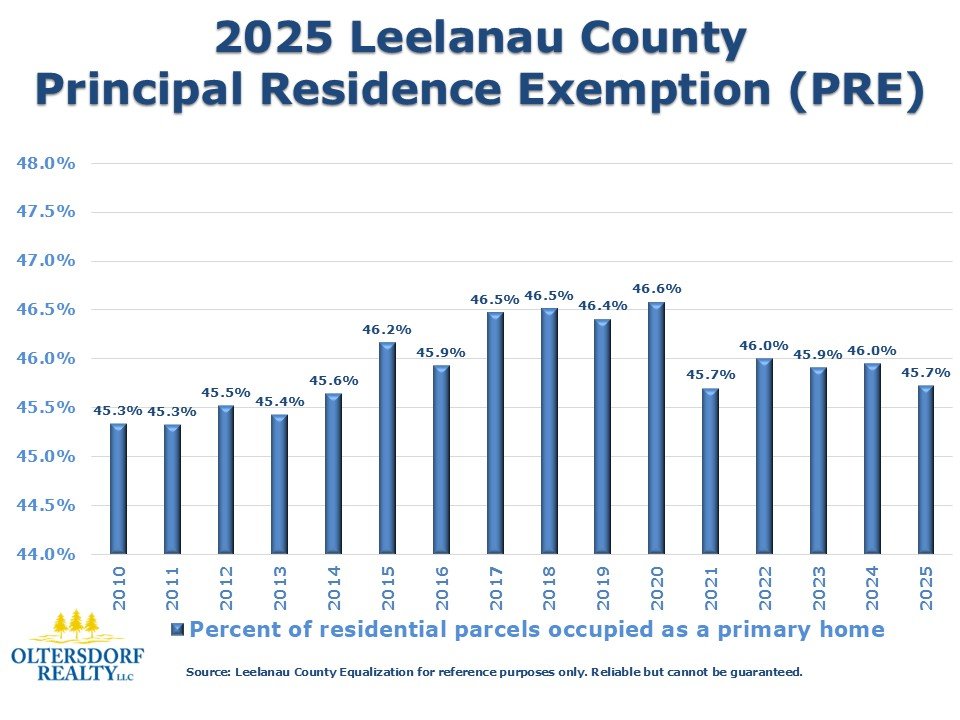
The chart above shows the percentage of residential parcels occupied as a primary home in Leelanau County from 2010 through 2025, based on Equalization Department data. And while the year-to-year changes may look small, the long-term trend tells a bigger story about housing pressure, second-home ownership, and inventory constraints.
What Is the Principal Residence Exemption (PRE)?
In Michigan, a Principal Residence Exemption indicates that a property is the owner’s primary residence. Homes with a PRE are typically occupied year-round by local residents, while parcels without a PRE are often:
Seasonal or vacation homes
Short-term or long-term rentals
Investment properties
Second homes owned by out-of-area buyers
Tracking PRE percentages is one of the best ways to measure how much of a community’s housing stock is truly serving full-time residents.
Key Takeaways from the 2010–2025 Leelanau County PRE Data
1. Less than half of all parcels are primary residences
Throughout the entire 15-year period shown, the PRE rate stays in a narrow range—roughly 45% to 47%. That means a majority of residential parcels in Leelanau County are not occupied full-time.
This is a defining characteristic of the local real estate market and a major reason inventory remains tight even when sales slow.
2. The peak occurred around 2017–2020
PRE percentages climbed steadily from 2010 and peaked around 2017–2020, topping out near 46.6%. This period coincides with:
Strong in-migration before and during the early COVID years
Buyers converting second homes into primary residences
Increased remote work flexibility
3. A post-2020 pullback reflects market reality
After 2020, the PRE percentage dips slightly and stabilizes again in the mid-45% range. This suggests:
Continued demand for seasonal and second homes
Investors and lifestyle buyers remaining active
Fewer homes converting to full-time residences than many expect
Despite record-setting sales activity earlier this decade, Leelanau County has not shifted into a majority full-time resident market.
Why PRE Trends Matter for Buyers and Sellers
For Buyers:
Low PRE percentages mean you’re competing in a market with:
Fewer owner-occupied listings
Higher competition for year-round homes
Zoning and rental rules that matter more than in typical markets
Understanding PRE data helps buyers set realistic expectations and make smarter offers.
For Sellers:
Homes that work well as primary residences often attract a different buyer pool than vacation or rental-focused properties. Knowing where demand actually comes from can directly affect pricing, timing, and marketing strategy.
For Policy and Long-Term Planning:
PRE data also plays a role in conversations about workforce housing, school enrollment, and local services—topics that continue to shape Leelanau County’s future.
Bottom Line
Leelanau County’s real estate market is not driven primarily by year-round residents—and the data proves it. For more than a decade, over half of all residential parcels have been non-primary residences, and that reality continues in 2025.
Anyone buying, selling, or investing here needs to understand this dynamic. It impacts values, inventory, negotiations, and long-term appreciation.
Want Local Data That Actually Matters?
I regularly analyze Leelanau County real estate trends, including sales, financing, cash purchases, and housing use patterns like PRE. If you want data-driven insight instead of national headlines, you’re in the right place.
Need Expert Real Estate Advice? Contact Jonathan Oltersdorf Today!
For personalized insights into Leelanau County real estate, reach out to Jonathan Oltersdorf at Oltersdorf Realty, LLC.
📞 Office Phone: 231-271-7777
📧 Email: jonathan@oltersdorf.com
🌐 Website: www.oltersdorf.com